Competition Resources
Take Your Skills to the Next Level
The Michigan FCCLA Competitive Events Program provides opportunities for members to be recognized for proficiency and achievement in chapter and individual projects, leadership skills, and career preparation. Competitive Events give you the chance to take what you've learned in the classroom and put it into action. Whether you're interested in education, culinary arts, fashion, hospitality, or other careers, there's an opportunity to showcase your talents, explore your interests, and challenge yourself.
Through competition, you'll build real-world skills in communication, leadership, problem-solving, creativity, and teamwork. You'll gain confidence, receive valuable feedback, connect with students who share your interests, and develop skills that can help you succeed in college, your career, and beyond.
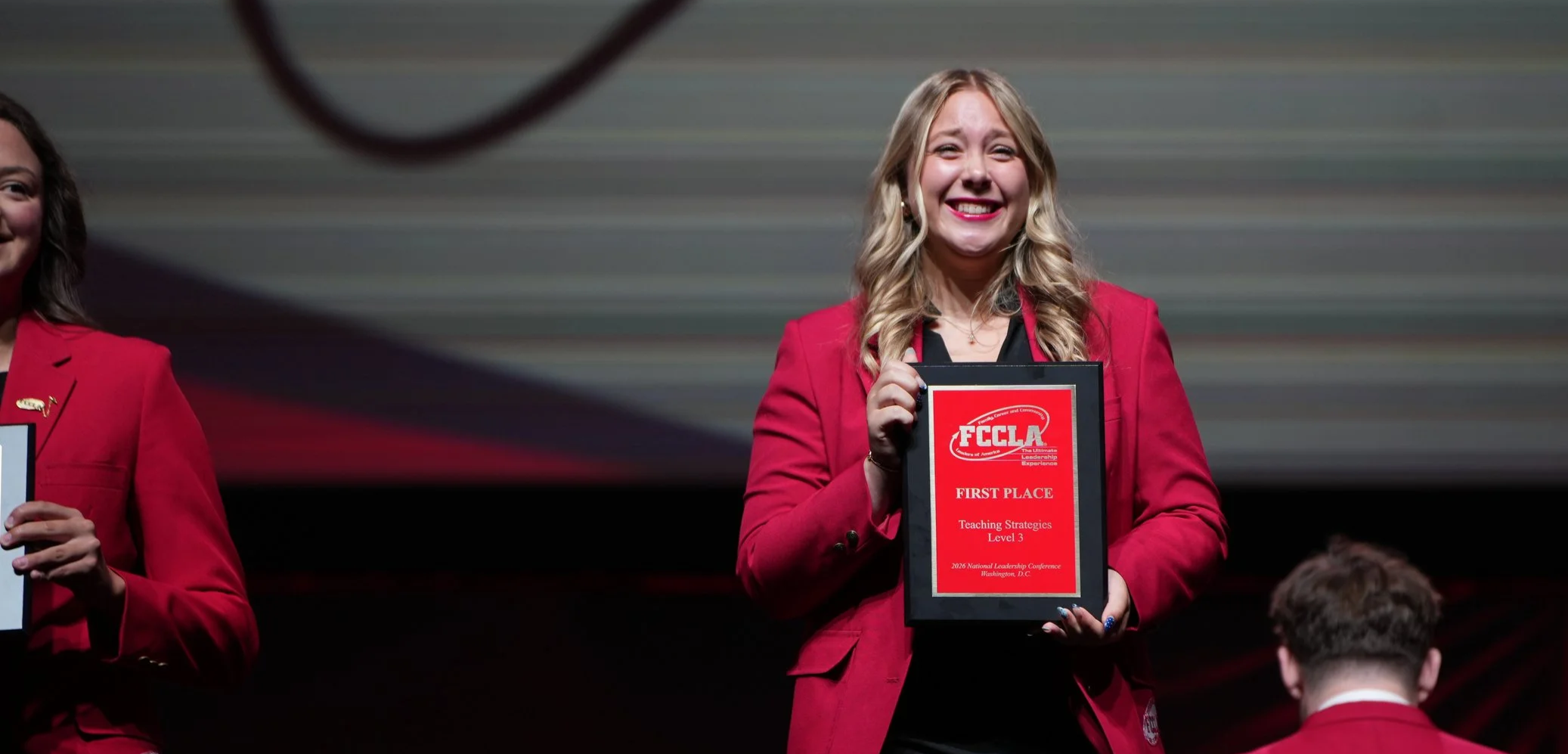
Competitive Events give you the opportunity to earn recognition for your hard work, represent your chapter on stage, and potentially advance to compete at the National Leadership Conference.
Take the STAR Event Quiz!
Not sure which STAR Event is for you? The following quiz can help you narrow down your choices. Be sure to ask your chapter adviser for the STAR Event guidelines and discuss any eligibility criteria before making your final decision!
Note that Baking & Pastry, Culinary Arts, and Parliamentary Procedure are not currently offered in Michigan, but they could become available in future years if there is enough interest from chapters. Check with your chapter adviser or the state office to make sure the event you want to compete in is offered at the State Leadership Conference.
Reach out with any questions: info@mifccla.org
Quiz provided by National FCCLA. fcclainc.org
Michigan FCCLA Competition Categories
-
Students Taking Action with Recognition (STAR) events created by National FCCLA. The top 3 entries in each category and level, who score a gold rating, will represent Michigan the National Leadership Conference.
-
Students Taking Action with Recognition (STAR) events created by Michigan FCCLA. The highest scoring gold-rated entry in each category will be recognized as the State Champion. These events do not advance to the National Leadership Conference.
-
Michigan Skill Events are events specifically focused on demonstrating a specific industry-related skill. These events are smaller-scale and focus on application rather than research and prepared presentation. The highest scoring gold-rated entry in each category will be recognized as the State Champion. These events do not advance to the National Leadership Conference, but National FCCLA offers “Skill Demonstrations" which are similar to these events.
The FCCLA Planning Process
The FCCLA Planning Process is a decision-making model for setting goals, planning, and carrying out projects. It is used to make decisions and accomplish tasks for both groups and individuals. Michigan FCCLA encourages members to start filling out their Planning Process before beginning their project and to use the document as a tool to help them with their preparations along the way.
The Planning Process contains five steps:
Identify Concerns
Set a Goal
Form a Plan
Act
Follow Up
All National STAR Events and Michigan STAR Events (except Anchor Chart Challenge) use the Planning Process. Michigan Skill Events do not require use the Planning Process.
Planning Process Resources
This PowerPoint by National FCCLA outlines the philosophy and meaning behind each step of the Planning Process, along with recommendations for completing it.
When using this version, make sure you press "save with changes."
Tip: Type your answers in a separate document and paste them into the PDF when you are ready to finalize your document.
Most rubrics specify that the Planning Process must be one page. This means only one page, no more. Make sure your text is sized appropriately and written concisely to meet the one-page requirement!
Building Your FCCLA Portfolio
Many FCCLA competitive events are presented via portfolios. An FCCLA portfolio is a collection of project records, planning steps, research, and evidence contained within a binder that helps judges understand how your project came together and the expertise you bring to the project through skills learned in your CTE program and classes.
Michigan FCCLA has the following recommendations related to portfolios:
We recommend using hardcopy portfolios instead of electronic portfolios. Electronic portfolios require a powered laptop and occasionally an internet connection. Internet access and power are not available to competitors at the state or national level. There are more opportunities for things to go wrong with an electronic portfolio than with a hardcopy portfolio in a binder.
We recommend that competitors follow portfolio instructions exactly. Each STAR event rubric contains a section titled “Contents of Portfolio (Specifications)” that gives detailed instructions for assembling your portfolio. Follow the exact page/slide counts, titles, and order of contents to have the best chance at scoring full points on your portfolio.
Start thinking about your portfolio early. In many categories, the portfolio accounts for 55%-65% of your total score. A strong portfolio may be the difference between State Champion and missing out on stage recognition.
Your portfolio should be typed and neat. Ensure all fonts match. Don’t handwrite page numbers, correct mistakes in pencil, or leave eraser marks on pages. Portfolio appearance is key, and it is worth taking extra time to have a neat, polished product.
Prioritize professional completion over creative design. You may look at your finished portfolio and feel that it looks “boring,” especially the first few pages. Full completion of requirements is more important than having pages that look creative or unique. The oral presentation component is your opportunity to showcase your personal expression in the project.
All portfolio materials—including content divider pages, documents placed in portfolio pockets, and loose or removable papers—must fit within the portfolio cover, be one-sided, and remain within the established page limit. We recommend using page protectors for the final portfolio.
Frequently-Asked Portfolio Questions
-
National Rubrics contain a section on the first page titled “Presentation Elements Allowed” with squares in the chart indicating which elements are permitted.
-
Yes, portfolios must be presented in the official FCCLA binder at the state and national level. Both colors (red or white) are acceptable.
-
No. All pages must be one-sided. If two-sided pages are submitted, evaluators will review and score only the front side; content on the back will not be evaluated.
-
Content divider pages must fit within the portfolio cover when closed.
-
When you check in to compete, you will give your portfolio to the event coordinator, who will give it to the judges for review. Unless otherwise specified, you have the right to request this back from the judges and use it as part of your oral presentation.
Mastering the Oral Presentation
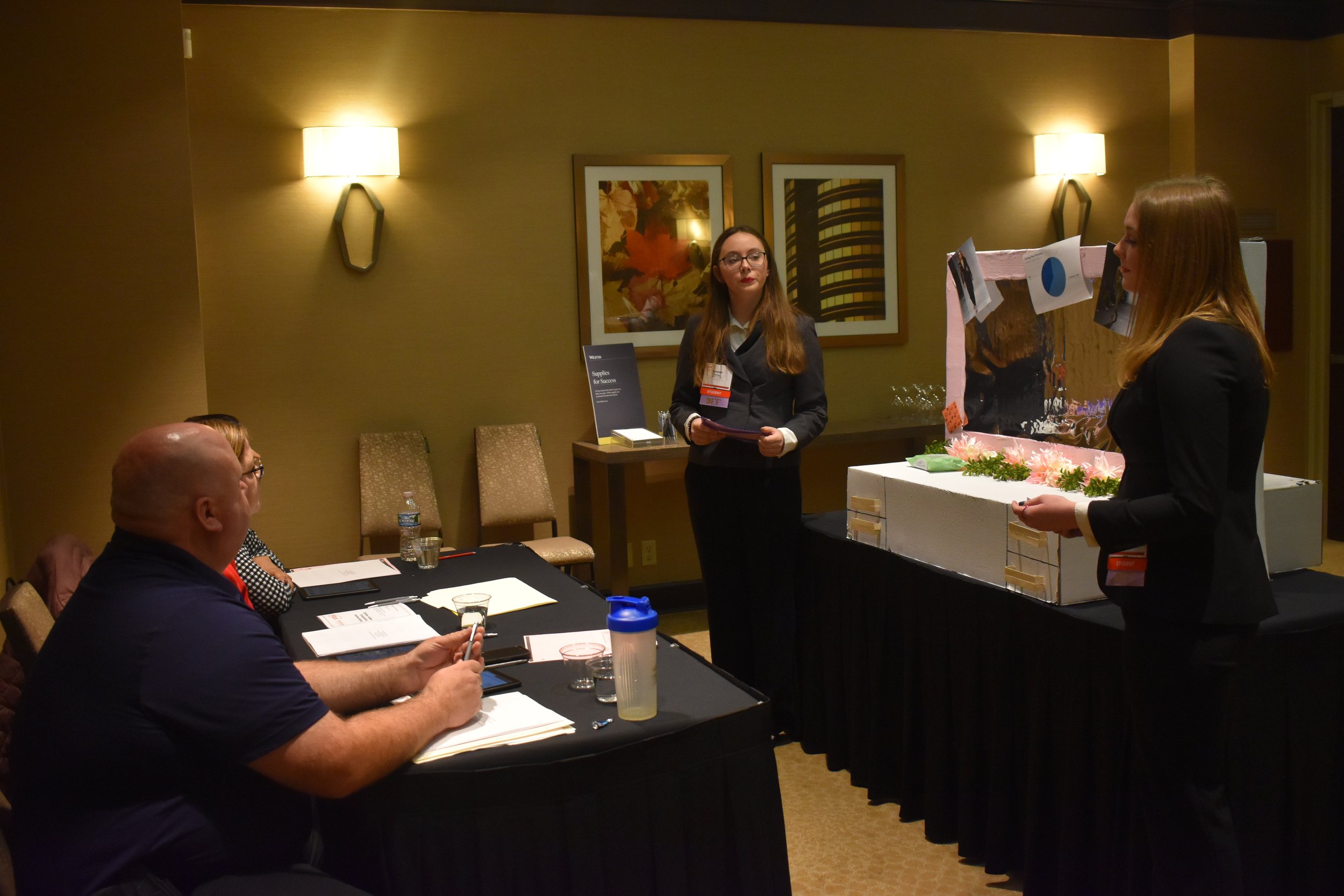
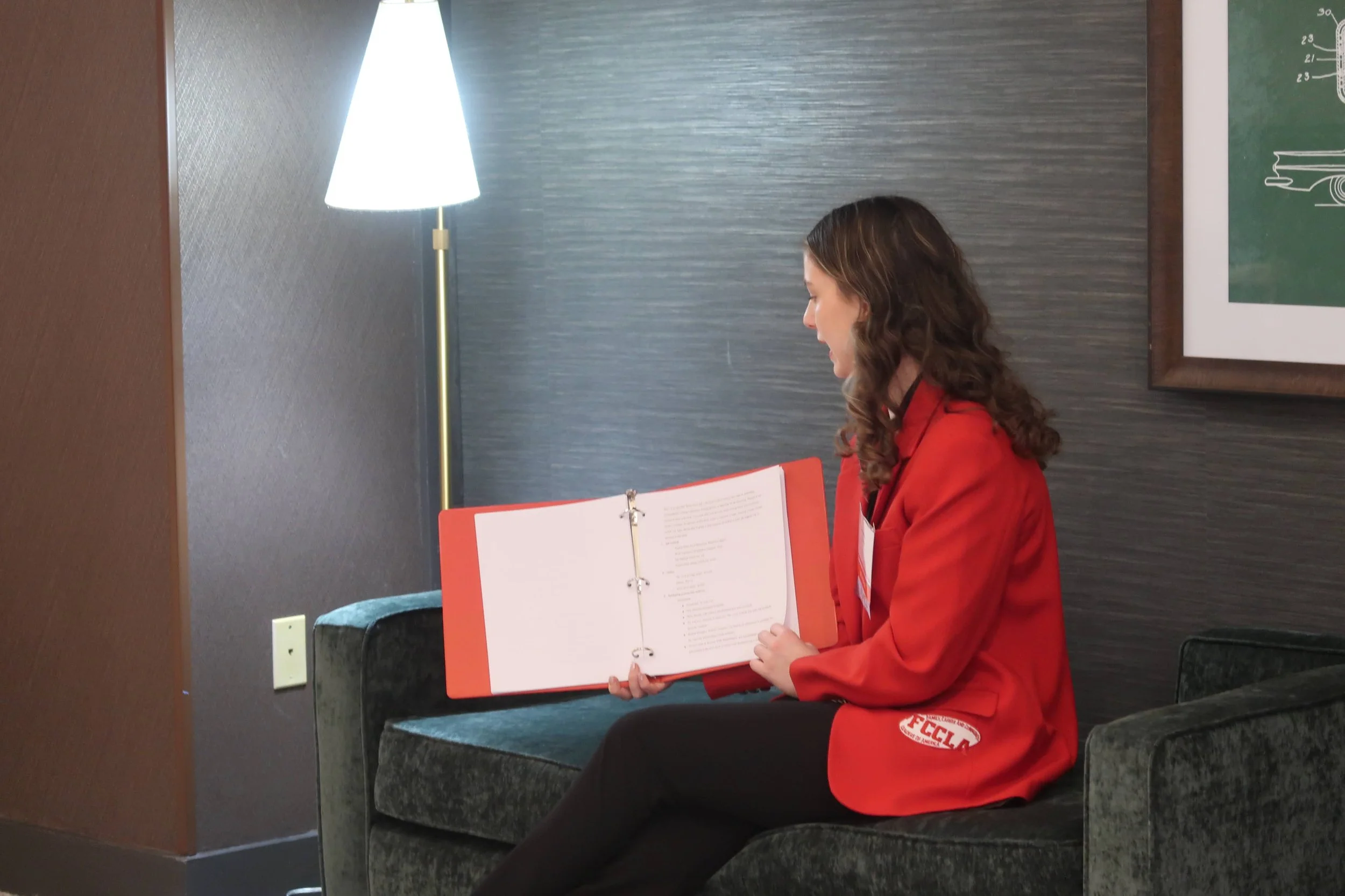
The highlight of competitive events is presenting your hard work to the judges at the State Leadership Conference. You will present in front of two judges for the time listed in your event guidelines. In most cases, this is between 10 and 15 minutes. The oral presentation typically represents 30%-35% of your total score.
Michigan FCCLA has the following recommendations related to oral presentations:
Align your oral presentation structure with your portfolio. It is challenging to flip back and forth in the portfolio while speaking. Synergy between portfolio and presentation outlines will create a smoother, more professional presentation.
In a team event, make sure all team members have equal opportunity to speak. Practice transitions between teammates, discuss visual cues, and what to do if one presenter gets stuck or loses their thought mid-presentation.
Practice early and often. Consistent preparation will result in better flow and delivery.
What you say and how you say it are both important. Confidence and clarity make a great impression on judges and help your presentation be more memorable.
Don’t forget about body language. Consider practicing your presentation in front of a mirror to ensure you look as confident as you sound. Move with intention and purpose, both with your arms and your legs, to command the presentation space.
Check if your event is a presentation or a role-play. This will determine if you talk at the judges or interact in a two-way dialogue with them throughout the presentation.
The goal is memorization. Note cards are permitted (maximum size 4”x6”), and there is no quantity limit. You will not be penalized for using note cards. Historically, most state and national champions deliver their presentations from memory. Memorization may help a competitor score higher in the organization/delivery and body language scoring categories.
Frequently-Asked Portfolio Questions